
Teaching Environmental Democracy: Reflections from the Supranational Democracy Dialogues 2026
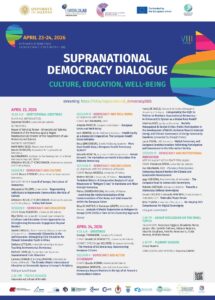
On 23 April 2026, I had the pleasure of presenting my intervention entitled “Teaching Environmental Democracy: From Pedagogical Design to Democratic Tensions” during the VIII edition of the Supranational Democracy Dialogues, within the session dedicated to Democracy and Education.
The presentation was inspired by the recently launched Erasmus+ project TED – Teaching Environmental Democracy, which I coordinate at the Université Catholique de Lyon (UCLy) in partnership with the Università del Salento, the Democracy and Culture Foundation (Athens), and CESUE / Focus Europe Italia.
The intervention explored a central question: how can environmental democracy be taught today in a context marked by ecological urgency, democratic tensions, and growing complexity?
Environmental democracy is often understood through procedural rights such as access to environmental information, public participation, and access to justice. However, contemporary environmental governance raises broader and more challenging questions related to democratic legitimacy, expertise, participation, urgency, and the shrinking of civic space.
The presentation argued that teaching environmental democracy cannot be limited to explaining legal frameworks or institutional procedures. It also requires addressing tensions, contradictions, and real-world environmental conflicts, while encouraging students to develop critical thinking, deliberative skills, and democratic competences.
Within the TED project, this pedagogical approach takes concrete form through the creation of a Students Assembly, where students are invited not only to analyse environmental issues but also to deliberate collectively and experience democratic decision-making processes in practice.
One particularly interesting aspect discussed during the conference concerned the first empirical feedback collected from student representatives involved in designing the Students Assembly rules. Their responses revealed important tensions between participation and efficiency, inclusiveness and organisation, deliberation and decision-making — highlighting how environmental democracy is not a fixed model, but an evolving and contested process.
The intervention concluded with a broader reflection on the role of universities in preparing future generations to navigate ecological transitions through legal knowledge, democratic participation, and interdisciplinary dialogue.
The TED project will continue developing innovative teaching methodologies on environmental democracy throughout the 2025–2028 period, contributing to the broader debate on democracy, sustainability, and environmental governance in Europe.