• Home
  • Stefania Attolini
  • Actualités et Approfondissements
  • Projets
    • T.E.D. – Teaching Environmental Democracy – Project
    • Democracy for Europe and Humanity: EUMANITY DEMOS
      • Working Group on “Environmental Democracy”
  • Publications
  • Contactez moi
  • Home
Stefania Attolini
  • Home
  • Stefania Attolini
  • Actualités et Approfondissements
  • Projets
    • T.E.D. – Teaching Environmental Democracy – Project
    • Democracy for Europe and Humanity: EUMANITY DEMOS
      • Working Group on “Environmental Democracy”
  • Publications
  • Contactez moi
  • Home
Stefania Attolini
Stefania Attolini
  • Home
  • Stefania Attolini
  • Pubblicazioni
  • Notizie & Eventi
  • Contatti
  • FrançaisFrançais
  • Tag:

    FundamentalRights

    ActualitésApprofondissements

    Le Pacte européen sur la migration et l’asile entre en application

    by Stefania Attolini 12 juin 2026

    Le Pacte européen sur la migration et l’asile entre en application (page site Commission européenne)

    Le 12 juin 2026 marque l’entrée en application du Pacte européen sur la migration et l’asile. Deux ans après son adoption, l’Union européenne dispose désormais d’un nouveau cadre juridique destiné à organiser la gestion des migrations autour de cinq priorités : la protection des frontières extérieures, des procédures d’asile plus rapides, des normes communes en matière d’accueil, un mécanisme permanent de solidarité entre États membres et un renforcement de la coopération avec les pays tiers.

    Cette réforme constitue l’une des évolutions les plus importantes du Système européen commun d’asile depuis sa création. Elle vise à répondre aux difficultés révélées par les crises migratoires de la dernière décennie tout en renforçant la cohérence de l’action européenne.

    Parmi les principales nouveautés figurent la mise en place d’un filtrage obligatoire aux frontières extérieures, une réforme du système Eurodac, des procédures d’asile plus rapides ainsi que de nouvelles règles destinées à limiter les mouvements secondaires entre États membres.

    Le Pacte entend également renforcer la solidarité entre États membres grâce à un mécanisme permanent permettant différentes formes de contribution, notamment par des relocalisations, un soutien opérationnel ou une assistance financière. Il prévoit en outre des règles plus claires pour déterminer l’État responsable de l’examen d’une demande d’asile.

    La réforme accorde enfin une place centrale à la dimension extérieure de la politique migratoire européenne. La coopération avec les pays d’origine et de transit, la lutte contre les réseaux de trafic de migrants et le développement de voies légales de migration sont désormais présentés comme des éléments complémentaires de la gestion des frontières et de l’asile.

    L’entrée en application du Pacte ne constitue toutefois qu’une étape. Comme le soulignent les institutions européennes, la réussite de cette réforme dépendra désormais de sa mise en œuvre effective par les États membres et de leur capacité à concilier efficacité administrative, solidarité européenne et respect des droits fondamentaux.

    12 juin 2026
    0 FacebookPinterestLinkedinWhatsappEmail
    ActualitésApprofondissements

    Beyond Refusal: The CJEU’s Rugu Judgment and the Execution of European Arrest Warrants

    by Stefania Attolini 8 juin 2026

    Judgment, 04/06/2026, Rugu, C-722/23

    On 4 June 2026, the Grand Chamber of the Court of Justice of the European Union delivered its judgment in Rugu (Joined Cases C-722/23 and C-91/24), addressing an important issue in the operation of the European Arrest Warrant (EAW) system: what obligations arise for the executing Member State when surrender must be refused because it would expose the requested person to a real risk of inhuman or degrading treatment?

    At first sight, the judgment appears to follow the well-established line of case law stemming from Aranyosi and Căldăraru, ML, and Dorobantu. The Court reiterates that surrender under a European Arrest Warrant cannot take place where substantial grounds exist for believing that the individual concerned would face a real risk of treatment contrary to Article 4 of the Charter of Fundamental Rights of the European Union.

    However, the most significant aspect of Rugu lies elsewhere.

    While previous case law focused primarily on the circumstances in which surrender may be refused, Rugu addresses a question that had remained largely unresolved: what obligations arise for the executing Member State once surrender has been refused on fundamental rights grounds?

    The judgment does not alter the principles established in the Court’s earlier case law. Rather, it explores their practical implications. The Court makes clear that refusing surrender cannot simply bring judicial cooperation to an end. Where the executing Member State declines to execute a European Arrest Warrant because of a real risk of inhuman or degrading treatment, it must nevertheless examine whether alternative mechanisms available under EU law may ensure the effective enforcement of the sentence.

    In particular, the Court highlights the relevance of the instruments governing the recognition and execution of criminal judgments within the European Union. The protection of fundamental rights cannot result in impunity. Instead, national authorities must consider whether the sentence can be enforced in the executing State, thereby reconciling respect for fundamental rights with the effectiveness of criminal justice.

    From this perspective, Rugu represents an important refinement of the Court’s approach to mutual trust. The judgment confirms that mutual trust remains a cornerstone of judicial cooperation in criminal matters, but it also reiterates that such trust cannot be blind. Where fundamental rights concerns prevent surrender, Member States are not released from their obligations of cooperation. On the contrary, they remain responsible for identifying alternative legal avenues capable of ensuring the enforcement of criminal sanctions.

    The significance of the judgment therefore lies less in the recognition of a ground for refusing surrender—which had already been firmly established in the Court’s case law—and more in its clarification of the responsibilities that follow such a refusal. In doing so, Rugu further develops the balance between mutual trust, effective judicial cooperation, and the protection of fundamental rights within the Area of Freedom, Security and Justice.

    Far from being a revolutionary judgment, Rugu illustrates the Court’s continuing effort to ensure that the protection of fundamental rights and the effectiveness of judicial cooperation are not treated as competing objectives, but as complementary requirements of the European legal order.

    8 juin 2026
    0 FacebookPinterestLinkedinWhatsappEmail
    ActualitésApprofondissements

    Magnifica Humanitas: Artificial Intelligence as a New Social Question

    by Stefania Attolini 1 juin 2026

    Read the Magnifica Humanitas (here)

    With the publication of Magnifica Humanitas (15 May 2026), Pope Leo XIV has placed artificial intelligence at the centre of the Catholic Church’s social reflection. Following the tradition inaugurated by Rerum novarum and developed through the major social encyclicals of the twentieth and twenty-first centuries, the new document addresses AI not merely as a technological innovation but as a phenomenon capable of reshaping work, democracy, human relationships and the understanding of human dignity itself.

    What makes Magnifica Humanitas particularly noteworthy is its attempt to frame artificial intelligence as a new social question. The encyclical calls for technological development to remain at the service of the human person and warns against forms of technological power that risk reducing individuals to data, predictions and measurable performance. At the same time, it highlights the need for responsibility, transparency, human oversight and international cooperation in the governance of emerging technologies.

    The document also contributes to a broader global debate that extends far beyond religious communities. Many of the concerns expressed by Pope Leo XIV resonate with principles increasingly found in international instruments on AI ethics and regulation, including human dignity, accountability, non-discrimination and the preservation of meaningful human control over automated systems.

    The publication of Magnifica Humanitas invites a deeper and more careful assessment of its potential significance and long-term implications. Beyond its immediate theological and ethical reflections, the document raises important questions concerning the governance of artificial intelligence, the role of human dignity in technological development, and the contribution of religious actors to global normative debates. Its broader impact on legal, political and institutional discussions surrounding emerging technologies will likely become clearer in the years ahead and deserves sustained scholarly attention.

    Looking ahead, the publication of Magnifica Humanitas is likely to stimulate further discussion among legal scholars, policymakers and technology experts about the ethical and institutional foundations of AI governance. Its reflections invite a broader conversation on how emerging technologies can be aligned with human dignity, social justice and the common good in an increasingly interconnected world.


    Magnifica Humanitas et la gouvernance mondiale de l’intelligence artificielle

    Avec la publication de Magnifica Humanitas (15 mai 2026), le pape Léon XIV place l’intelligence artificielle au cœur de la réflexion sociale de l’Église catholique. S’inscrivant dans la tradition inaugurée par Rerum novarum et développée par les grandes encycliques sociales des XXe et XXIe siècles, ce nouveau texte aborde l’IA non pas comme une simple innovation technologique, mais comme un phénomène susceptible de transformer le travail, la démocratie, les relations humaines et la compréhension même de la dignité humaine.

    L’un des aspects les plus remarquables de Magnifica Humanitas réside dans sa volonté de présenter l’intelligence artificielle comme une nouvelle question sociale. L’encyclique affirme que le développement technologique doit demeurer au service de la personne humaine et met en garde contre les formes de pouvoir technologique qui risquent de réduire les individus à des données, à des prédictions ou à des performances mesurables. Elle souligne également la nécessité de promouvoir la responsabilité, la transparence, le contrôle humain et la coopération internationale dans la gouvernance des technologies émergentes.

    Le document contribue également à un débat mondial qui dépasse largement les communautés religieuses. Nombre des préoccupations exprimées par Léon XIV rejoignent des principes de plus en plus présents dans les instruments internationaux consacrés à l’éthique et à la régulation de l’intelligence artificielle, notamment la dignité humaine, la responsabilité, la non-discrimination et la préservation d’un contrôle humain significatif sur les systèmes automatisés.

    La publication de Magnifica Humanitas invite à une réflexion plus approfondie sur sa portée et ses implications à long terme. Au-delà de ses dimensions théologiques et éthiques immédiates, le document soulève d’importantes questions relatives à la gouvernance de l’intelligence artificielle, au rôle de la dignité humaine dans le développement technologique et à la contribution des acteurs religieux aux débats normatifs mondiaux. Son influence sur les discussions juridiques, politiques et institutionnelles concernant les technologies émergentes se révélera probablement plus clairement dans les années à venir et mérite une attention scientifique soutenue.

    À l’avenir, Magnifica Humanitas devrait nourrir les réflexions des juristes, des décideurs publics et des experts des technologies sur les fondements éthiques et institutionnels de la gouvernance de l’intelligence artificielle. Ses analyses invitent à une réflexion plus large sur les conditions permettant d’orienter les technologies émergentes vers la dignité humaine, la justice sociale et le bien commun dans un monde toujours plus interconnecté.


    Magnifica Humanitas e la governance globale dell’intelligenza artificiale

    Con la pubblicazione della Magnifica Humanitas (15 maggio 2026), Papa Leone XIV ha posto l’intelligenza artificiale al centro della riflessione sociale della Chiesa cattolica. Inserendosi nella tradizione inaugurata dalla Rerum novarum e sviluppata attraverso le grandi encicliche sociali del XX e XXI secolo, il nuovo documento affronta l’IA non come una semplice innovazione tecnologica, ma come un fenomeno capace di trasformare il lavoro, la democrazia, le relazioni umane e la stessa comprensione della dignità della persona.

    Ciò che rende particolarmente significativa la Magnifica Humanitas è il tentativo di configurare l’intelligenza artificiale come una nuova questione sociale. L’enciclica richiama l’esigenza che lo sviluppo tecnologico rimanga al servizio della persona umana e mette in guardia contro forme di potere tecnologico che rischiano di ridurre gli individui a dati, previsioni e prestazioni misurabili. Al tempo stesso, sottolinea la necessità di promuovere responsabilità, trasparenza, supervisione umana e cooperazione internazionale nella governance delle tecnologie emergenti.

    Il documento contribuisce inoltre a un dibattito globale che va ben oltre le comunità religiose. Molte delle preoccupazioni espresse da Leone XIV trovano riscontro nei principi sempre più presenti negli strumenti internazionali dedicati all’etica e alla regolazione dell’intelligenza artificiale, tra cui la dignità umana, la responsabilità, la non discriminazione e la salvaguardia di un controllo umano significativo sui sistemi automatizzati.

    La pubblicazione della Magnifica Humanitas invita a una riflessione più approfondita sul suo significato e sulle sue implicazioni di lungo periodo. Al di là delle sue immediate dimensioni teologiche ed etiche, il documento solleva importanti interrogativi riguardanti la governance dell’intelligenza artificiale, il ruolo della dignità umana nello sviluppo tecnologico e il contributo degli attori religiosi ai dibattiti normativi globali. Il suo impatto sulle discussioni giuridiche, politiche e istituzionali relative alle tecnologie emergenti emergerà probabilmente con maggiore chiarezza negli anni a venire e merita un’attenzione scientifica costante.

    Guardando al futuro, la Magnifica Humanitas è destinata a stimolare ulteriori riflessioni tra studiosi del diritto, decisori pubblici ed esperti di tecnologia sui fondamenti etici e istituzionali della governance dell’intelligenza artificiale. Le sue considerazioni invitano a una più ampia discussione su come orientare le tecnologie emergenti verso la tutela della dignità umana, della giustizia sociale e del bene comune in un mondo sempre più interconnesso.

    1 juin 2026
    0 FacebookPinterestLinkedinWhatsappEmail
    ActualitésApprofondissementsLiens utiles

    Digital Borders and the Future of the Area of Freedom, Security and Justice

    by Stefania Attolini 29 mai 2026

    The European Union is entering a new phase in the evolution of the Area of Freedom, Security and Justice.

    As the Pact on Migration and Asylum approaches its full application in June 2026 and the Entry/Exit System (EES) becomes operational across the Schengen Area, the governance of migration and border management is increasingly shaped by digital technologies, biometric identification, and large-scale information systems.

    These reforms are intended to strengthen migration management, improve security, and enhance cooperation among Member States. At the same time, they raise important legal and constitutional questions concerning privacy, data protection, proportionality, and the protection of fundamental rights.

    The ongoing transformation of the Area of Freedom, Security and Justice therefore reflects a broader development within European integration: the growing interconnection between internal security, digital governance, and the management of mobility.

    Recent reports have also highlighted practical concerns linked to the deployment of the Entry/Exit System, including delays, operational challenges, and potential disruptions at major border crossing points and airports. These developments show how technological governance is becoming an increasingly central component of European migration and security policy.

    One crucial question nevertheless remains open: can the European Union reconcile increasingly sophisticated systems of border control with the fundamental values of freedom, rights, and the rule of law on which the Area of Freedom, Security and Justice is founded?

    Useful Sources

    • Pact on Migration and Asylum – European Commission
      https://home-affairs.ec.europa.eu/policies/migration-and-asylum/pact-migration-and-asylum_en
    • Commission Report on the Implementation of the Pact (May 2026)
      https://home-affairs.ec.europa.eu/news/commission-reports-progress-implementing-pact-migration-and-asylum-2026-05-08_en
    • Entry/Exit System (EES) – European Commission
      https://home-affairs.ec.europa.eu/policies/schengen/smart-borders/entry-exit-system_en
    • Travel Europe – Entry/Exit System Guide
      https://travel-europe.europa.eu/en/ees
    • eu-LISA – Entry/Exit System Information
      https://www.eulisa.europa.eu/Activities/Large-Scale-It-Systems/ees
    • The Guardian – Concerns over EES implementation and border delays
      https://www.theguardian.com/business/2026/apr/30/eu-entry-exit-system-ees-queues-missed-flights-readers
    29 mai 2026
    0 FacebookPinterestLinkedinWhatsappEmail
    ActualitésLiens utiles

    Nomination à la vice-présidence de la Maison de l’Europe Albertville-Savoie

    by Stefania Attolini 3 juin 2025

    Hier, 2 juin 2025, à l’occasion du Conseil d’Administration de la Maison de l’Europe Albertville-Savoie (MDEAS), j’ai eu l’honneur d’être élue vice-présidente de l’association.

    Je remercie sincèrement les membres du Conseil d’Administration pour leur confiance. Cette nomination représente pour moi une responsabilité importante ainsi qu’une belle opportunité de contribuer davantage aux activités de la MDEAS, dont la mission est de promouvoir la citoyenneté européenne, le dialogue interculturel et les valeurs qui fondent le projet européen.

    Cette nouvelle gouvernance s’inscrit dans la continuité du remarquable travail accompli pendant dix-huit années par Henri-Georges Brun, dont l’engagement constant a largement contribué au rayonnement de la Maison de l’Europe en Savoie. Je tiens à saluer son action et à le remercier pour son investissement au service de l’Europe et des citoyens.

    Aux côtés du nouveau président Luc Martin, de l’ensemble des membres du bureau et du Conseil d’Administration, je suis heureuse de participer à cette nouvelle étape de la vie de l’association. Dans un contexte international marqué par de nombreux défis, la promotion des valeurs européennes, de la démocratie, de la paix et de la coopération apparaît plus essentielle que jamais.

    Je me réjouis de poursuivre cet engagement collectif au service de l’Europe, de ses citoyens et des générations futures.


    3 juin 2025
    0 FacebookPinterestLinkedinWhatsappEmail
    ActualitésApprofondissements

    Journée de l’Europe 2025 avec la Maison de l’Europe d’Albertville et de la Savoie (MDEAS)

    by Stefania Attolini 18 mai 2025

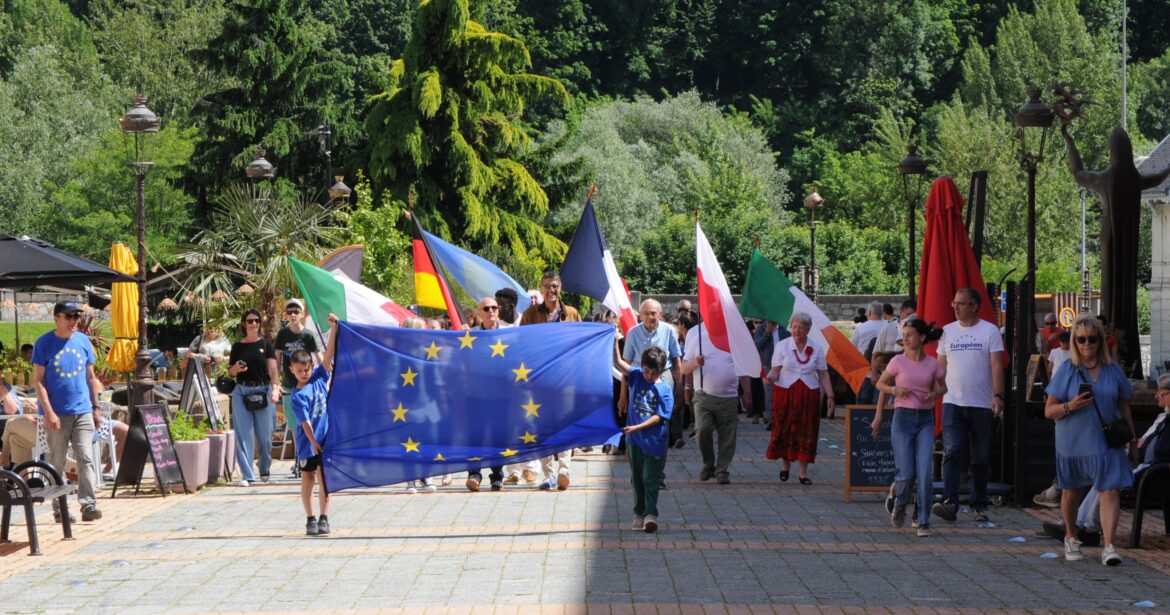
    J’ai eu le plaisir de participer à la Journée de l’Europe organisée par la Maison de l’Europe Albertville-Savoie (MDEAS), un événement consacré à la promotion des valeurs européennes, du dialogue interculturel et de la citoyenneté européenne.

    L’un des moments les plus marquants de cette journée a été la lecture collective de passages de la Déclaration Schuman du 9 mai 1950, texte fondateur de la construction européenne. Des participants de différentes nationalités ont lu, chacun dans sa propre langue, des extraits de cette déclaration historique prononcée par Robert Schuman. Ce texte proposait la mise en commun de la production franco-allemande de charbon et d’acier, posant ainsi les bases d’une coopération destinée à rendre la guerre « non seulement impensable, mais matériellement impossible » entre les nations européennes.

    Cette initiative symbolique a rappelé la richesse de la diversité linguistique et culturelle de l’Europe, tout en soulignant les valeurs communes qui unissent ses citoyens.

    Chaque année, le 9 mai est célébré comme la Fête de l’Europe, en mémoire de la Déclaration Schuman. Cette date marque le point de départ du processus d’intégration européenne qui conduira à la création de l’Union européenne telle que nous la connaissons aujourd’hui. Elle constitue une occasion privilégiée de réfléchir à l’histoire de la construction européenne, à ses réalisations, mais aussi aux défis auxquels l’Europe est confrontée dans un contexte international en constante évolution.

    En tant que membre de la MDEAS, j’ai été particulièrement heureuse de contribuer à cette belle journée d’échanges, de mémoire et de réflexion sur l’avenir du projet européen, qui illustre pleinement l’engagement de l’association en faveur de la citoyenneté européenne et du dialogue entre les peuples.

    Comme le rappelait Robert Schuman dans sa déclaration du 9 mai 1950 :

    « La paix mondiale ne saurait être sauvegardée sans des efforts créateurs à la mesure des dangers qui la menacent. »

    Et encore :

    « L’Europe ne se fera pas d’un coup, ni dans une construction d’ensemble : elle se fera par des réalisations concrètes créant d’abord une solidarité de fait. »

    Soixante-quinze ans plus tard, ces mots conservent toute leur actualité et continuent d’inspirer celles et ceux qui croient dans un projet européen fondé sur la paix, la solidarité et la coopération entre les peuples.


    18 mai 2025
    0 FacebookPinterestLinkedinWhatsappEmail
    juin 2026
    L M M J V S D
    1234567
    891011121314
    15161718192021
    22232425262728
    2930  
    « Mai    

    Qui Suis-Je?

    Qui Suis-Je?

    Stefania Attolini, Ph.D

    Juriste et chercheuse en droit de l’Union européenne, spécialisée dans les enjeux juridiques de la transition numérique et verte, la démocratie environnementale et la gouvernance des données.

    Rester en contact

    Facebook Instagram Linkedin Email

    Messages récents

    • Le Pacte européen sur la migration et l’asile entre en application

      12 juin 2026
    • The EU Publishes the Code of Practice on Transparency of AI-Generated Content

      10 juin 2026
    • Beyond Refusal: The CJEU’s Rugu Judgment and the Execution of European Arrest Warrants

      8 juin 2026
    • The EU Strategic Roadmap for Digitalisation and AI in the Energy Sector: Pillars and Flagship Actions

      4 juin 2026
    • European Tech Sovereignty and Open Source: The European Commission’s New Digital Strategy

      4 juin 2026

    Categoriés

    • Actualités (32)
    • Approfondissements (12)
    • Liens utiles (3)
    • Projects (4)
    • TED Project (4)
    • TEDNews (2)
    • Facebook
    • Twitter
    • Instagram
    • Linkedin
    • Email

    @2024 - Stefania Attolini | Privacy Policy - Cookie Policy | Powered by LnW Digital Strategies


    Retour au sommet
    Stefania Attolini
    • Home
    • Stefania Attolini
    • Actualités et Approfondissements
    • Projets
      • T.E.D. – Teaching Environmental Democracy – Project
      • Democracy for Europe and Humanity: EUMANITY DEMOS
        • Working Group on “Environmental Democracy”
    • Publications
    • Contactez moi